




Reading Age Labels on Toys
What Ages 3+ means, which warnings are required, how the age gets chosen, and what a label can't tell you about magnets, batteries, and siblings.

- Ages 0–8
- Researched
“Ages 3+” on a toy means the maker intends it for children 3 and older, and it often signals small parts that could choke a younger child. Federal rules ban small parts in toys meant for kids under 3, while numbers like 8+ or 14+ are the maker’s developmental guidance. Here is how to read each label and what it can’t tell you.
What does “Ages 3+” mean on a toy?

A toddler in red holds a plastic toy inside a play bin (stock photo).
The 3+ line comes from the federal small-parts rule at 16 CFR part 1501. It bans small parts in toys meant for children under 3, and it does not apply to toys “solely intended for use by children 3 years of age or older.”
A small part is anything that fits entirely inside a test cylinder, in any position, without being squeezed. The cylinder is 1.25 inches wide, with a slanted bottom 1 inch deep on one side and 2.25 inches on the other. The Consumer Product Safety Commission (CPSC) says its size approximates “the fully expanded throat of a child under three years old.”
Toys for under-3s must also pass drop, bend, twist, pull, and squeeze tests without shedding such a piece. As The Toy Association puts it, “age grading is based largely on safety and not on how smart a child may be.”
Bottom line: A 3+ label usually means small parts. Keep the toy from children under 3 and from older kids who still mouth things.
Which warning labels should you look for?

A young child plays with a wooden marble run (stock photo).
Toys for ages 3 to under 6 with small parts must carry a choking warning under a “WARNING” heading. CPSC’s Publication 282, its Child Safety Protection Act fact sheet, gives the wording:
- Small parts: “CHOKING HAZARD - Small parts. Not for children under 3 yrs.”
- A toy for ages 3 to under 8 with a small ball: “CHOKING HAZARD-Toy contains a small ball. Not for children under 3 yrs.”
- A toy for ages 3 to under 8 with a marble: “CHOKING HAZARD - Toy contains a marble. Not for children under 3 yrs.”
- Balloons: “CHOKING HAZARD-Children under eight yrs. can choke or suffocate on uninflated or broken balloons.”
A small ball is one that passes through a 1.75-inch hole, and balls that size meant for children under 3 are banned outright. Federal law also requires these warnings in ads that let you buy directly, including websites, so the listing should match the box.
Who decides the age on the box?

A child plays with wooden animal shapes at a table (stock photo).
The maker sets the age, but CPSC can overrule it. Under part 1501, a toy’s intended age depends on the maker’s stated intent if it is reasonable, how the toy is marketed, and what people commonly see it as. CPSC staff’s guidance says a toy they judge to be for under-3s “is subjected to the Small Parts Regulation, regardless of its age labeling.”
Makers work from CPSC staff’s 2020 Age Determination Guidelines, which match a product’s features “to the skills, play behaviors, and interests of children in a particular age group.” Testing is set for three bands: 18 months or under, over 18 to 36 months, and over 36 to 96 months. A toy that spans bands, or carries an unclear label, gets the strictest tests.
Do companies stamp 3+ to skip testing?
Some parents believe so; in one r/beyondthebump thread, commenters said under-3 testing costs more (thread). Here is what the rules say. A 3+ toy skips the under-3 ban and its tests, but every toy must still comply with ASTM F963-23, the mandatory toy standard. Children’s products for ages 12 and under also need a Children’s Product Certificate based on testing by a CPSC-accepted third-party lab.
Design can change a label, too. One r/toddlers parent noted a speaker toy whose newer version dropped to 1+ after its long charging cord was replaced (thread).
What is the difference between 3+ and 8+ or 14+?

A toddler holds a ring-stacking toy near the sofa (stock photo).
A box can carry two kinds of numbers. The under-3 line is a legal safety line, while grades like 8+ or 14+ are the maker’s developmental call on skills, play, and interests.
| Label you see | What it means | Where it comes from |
|---|---|---|
| Ages 3+ with a choking warning | Small parts, a small ball, or a marble; keep from under-3s | Small-parts rule (16 CFR 1501) and label rule (16 CFR 1500.19) |
| “Not for children under 3 yrs.” | Required choking warning on toys for ages 3 to under 6 or 8 | CPSC Publication 282 wording |
| Balloon warning for under 8 | Uninflated or broken balloons can choke or suffocate | Child Safety Protection Act |
| Ages 2+ or 18 months+ | Made for under-3s: covered by the small-parts ban and use-and-abuse tests | 16 CFR 1501 and 1500.50–1500.53 |
| Ages 8+ or 14+ | Developmental grade for skills, play, and interests | Maker’s age grading, CPSC staff’s 2020 guidelines |
| Adult supervision on a chemistry set | Contains chemicals; use only with an adult | 16 CFR 1500.83 |
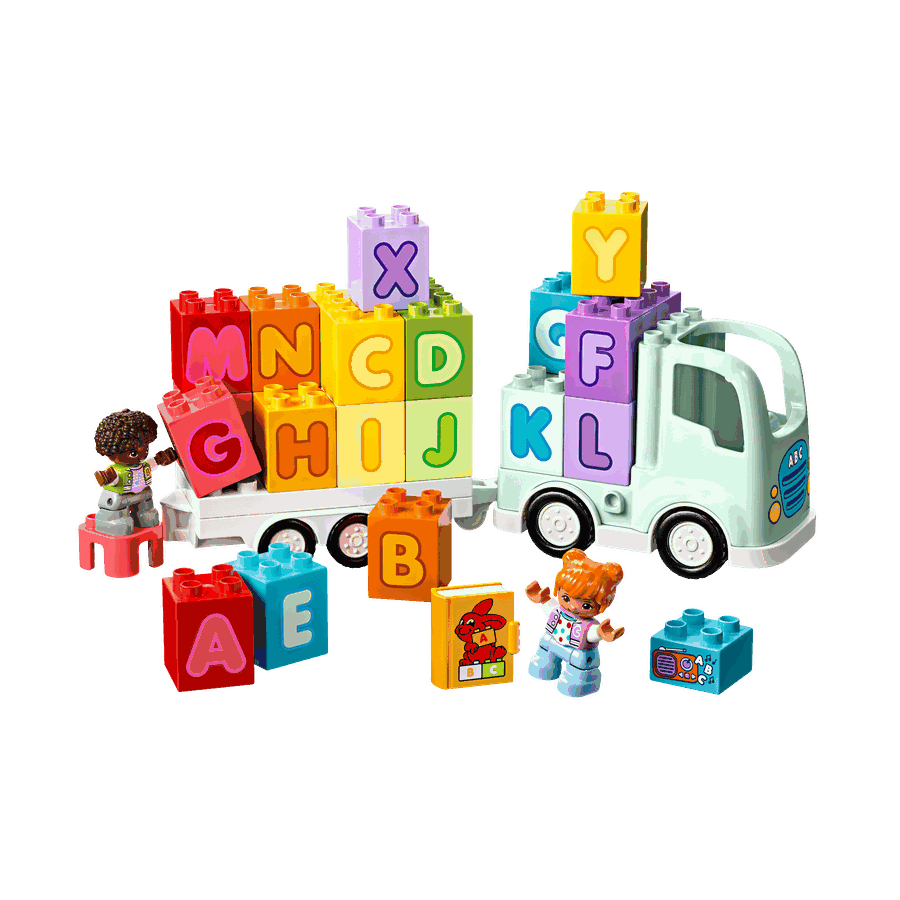
For an example below the line, LEGO rates its DUPLO Alphabet Truck (10421) 2+, with 36 pieces, at a $39.99 list price (LEGO’s product page). Because LEGO intends it for children under 3, it falls under the small-parts rule. We cover a DUPLO set rated 2+ in more detail.

LEGO
LEGO DUPLO Alphabet Truck 10421
A DUPLO truck with alphabet bricks for builders aged 2 and up.
- Ages 2+
- 36 pieces
- Researched
Best for: Toddlers aged 2+ starting letter play
Show priceChecked Sep 30, 2026
Some purchase links may earn us a commission. We identify affiliate links near the button.
At the top end, ASTM F963 covers toys for children under 14, so a 14+ grade marks an item aimed at teens and adults. Nemours KidsHealth notes that “the age levels for toys are determined by safety factors, not intelligence or maturity.”
What can’t a home small-parts check catch?

A baby mouths a toy beside a water play table (stock photo).
Comparing pieces to the cylinder’s size covers one hazard. These need their own attention:
- Magnets: the federal magnet rule exempts toys because the toy standard covers them. CPSC advises keeping high-powered magnets away from young children.
- Button and coin batteries: Reese’s Law aims to protect children 6 and younger from swallowing them; toys meeting the toy standard’s battery rules are exempt.
- Cords: one r/toddlers parent’s checklist adds long cords to button batteries and sharp or breakable parts.
- Broken pieces: a cracked toy can shed a piece that fits in the cylinder.
- Kids who still mouth after 3: The Toy Association notes toys for older kids can pose a choking risk to children who mouth objects.
Bottom line: The label covers the toy as sold. Supervise play, check for damage, and keep batteries and magnets out of reach at any age.
How do you handle kids of different ages at home?

A mother helps a toddler fit large plastic pieces together (stock photo).
CPSC’s holiday flyer says to “Keep toys for older children away from the younger ones.” In an r/Parenting thread about a crawling baby and an older sibling’s LEGO, parents turned the playpen into a LEGO pen that keeps the baby out (thread). Others kept small toys in a bedroom or at the table, used baby gates, or built on a sheet or tray, and Barbie shoes came up as a common floor find.
In the r/toddlers thread, parents said younger siblings end up with older kids’ toys anyway, so they stored small pieces and made some toys supervised-only. Stocking the baby’s area with toys made for babies and toddlers gives the youngest something of their own.
How do you check a toy for recalls?

A toy store display with a red toy fire truck (stock photo).
Search the toy’s name on cpsc.gov/Recalls, where you can also sign up for recall emails. On SaferProducts.gov, also run by CPSC, the public can file and read complaints. Check both before passing down an older toy.
“Shoppers should be especially cautious about unsafe or counterfeit products sold from foreign countries”
Peter A. Feldman, Acting Chairman, U.S. Consumer Product Safety Commission
The Toy Association’s Joan Lawrence adds that “it’s crucial to be able to spot counterfeit toys lurking online.” Our toy picks with the age guidance spelled out list the maker’s age rating for every product.
Bottom line: Buy from sellers you know, read the label and the listing, and check the recall database before handing down old toys.
FAQs
Sources
- U.S. Consumer Product Safety Commission. Child Safety Protection Act Fact Sheet (Publication 282)
- U.S. Consumer Product Safety Commission. Summary Information for Small Parts, 16 CFR Part 1501
- Office of the Federal Register (eCFR). 16 CFR Part 1501: Method for identifying toys and other articles intended for use by children under 3 years of age which present choking, aspiration, or ingestion hazards because of small parts
- U.S. Consumer Product Safety Commission and NICHD, National Institutes of Health. Age Determination Guidelines: Relating Consumer Product Characteristics to the Skills, Play Behaviors, and Interests of Children (2020)
- Peter A. Feldman, Consumer Product Safety Commission Acting Chairman, U.S. Consumer Product Safety Commission. Don’t Be Left Out in the Cold This Holiday Season with Unsafe Presents: Buy from Trusted Sources
- Joan Lawrence, The Toy Association’s “Toy Safety Mom” and senior vice president of standards and regulatory affairs, The Toy Association. Toy Safety Awareness Month Kicks off this November
- The Toy Association. The Toy Association Statement on Toy Safety, Age Grading and Small Parts
- Nemours KidsHealth. Choosing Safe Toys for School-Age Kids
Toys in this guide.
1 toy
Was this guide helpful?
Thanks for telling us.